
How LLMs Are Transforming Enterprise Integration Patterns
Exploring how Large Language Models are reshaping application integration, from automated data mapping to intelligent API orchestration
Enterprise integration has always been one of the most challenging aspects of IT architecture. Connecting disparate systems (each with their own data models, APIs, and protocols) traditionally requires extensive manual effort, deep domain expertise, and ongoing maintenance. But Large Language Models (LLMs) are fundamentally changing this equation.
After 20+ years of building integration solutions, I’m seeing a shift that rivals the move from point-to-point integrations to ESBs, or from on-premise middleware to cloud iPaaS. This post explores how LLMs are transforming integration patterns and what it means for architects and developers.
The Traditional Integration Challenge
Anyone who has worked on enterprise integration knows the pain points:
- Schema mapping between systems with different data models
- Data transformation logic that handles edge cases and business rules
- API documentation that’s incomplete, outdated, or non-existent
- Protocol translation between REST, SOAP, GraphQL, and legacy formats
- Error handling across systems with different failure modes
These tasks are labor-intensive and require specialists who understand both the technical protocols and the business domain. Industry surveys consistently show that data professionals spend 60-80% of their time on data preparation tasks—collecting, cleaning, and organizing data before actual analysis can begin.1
Where LLMs Add Value
LLMs bring capabilities that directly address integration pain points:
1. Automated Schema Matching
LLMs excel at understanding semantic relationships between data fields. When mapping between a Salesforce Contact and a SAP Business Partner, an LLM can identify that AccountName and BP_COMPANY_NAME represent the same concept—even without explicit documentation.
# Example: Using an LLM for schema matchingprompt = """Source schema (Salesforce Contact):- FirstName, LastName, Email, AccountName, Phone, MailingAddress
Target schema (SAP Business Partner):- BP_FIRST_NAME, BP_LAST_NAME, BP_EMAIL, BP_COMPANY_NAME,  BP_PHONE_NUMBER, BP_ADDRESS_FULL
Identify matching fields and confidence levels."""
Research presented at ICSE 2025 demonstrates that LLM-powered data mapping assistants provide significant precision improvements over traditional automated matching methods, particularly for complex enterprise schemas where semantic understanding is crucial.2
2. Transformation Logic Generation
Beyond matching fields, LLMs can generate the transformation logic itself. Given examples of source and target data, they can infer rules for:
- Date format conversions
- Address parsing and normalization
- Unit conversions
- Conditional mappings based on business rules
# LLM-generated transformationdef transform_address(salesforce_address): """ Transform Salesforce MailingAddress compound field to SAP BP_ADDRESS_FULL format """ components = [ salesforce_address.get('street', ''), salesforce_address.get('city', ''), salesforce_address.get('state', ''), salesforce_address.get('postalCode', ''), salesforce_address.get('country', '') ] return ', '.join(filter(None, components))3. API Documentation and Discovery
LLMs can analyze API responses and generate documentation, OpenAPI specs, or integration guides. This is particularly valuable for:
- Legacy systems with poor documentation
- Third-party APIs where you only have access to responses
- Internal APIs that have evolved beyond their original specs
4. Natural Language to Integration Logic
Perhaps most transformative is the ability to express integration requirements in natural language and have the LLM generate the implementation:
“When a new order is placed in Shopify, create a corresponding sales order in SAP, but only if the order total exceeds $500 and the customer exists in our SAP system. If the customer doesn’t exist, create them first using the Shopify customer data.”
An LLM can parse this requirement and generate the workflow logic, API calls, and error handling.
A Practical Architecture Pattern
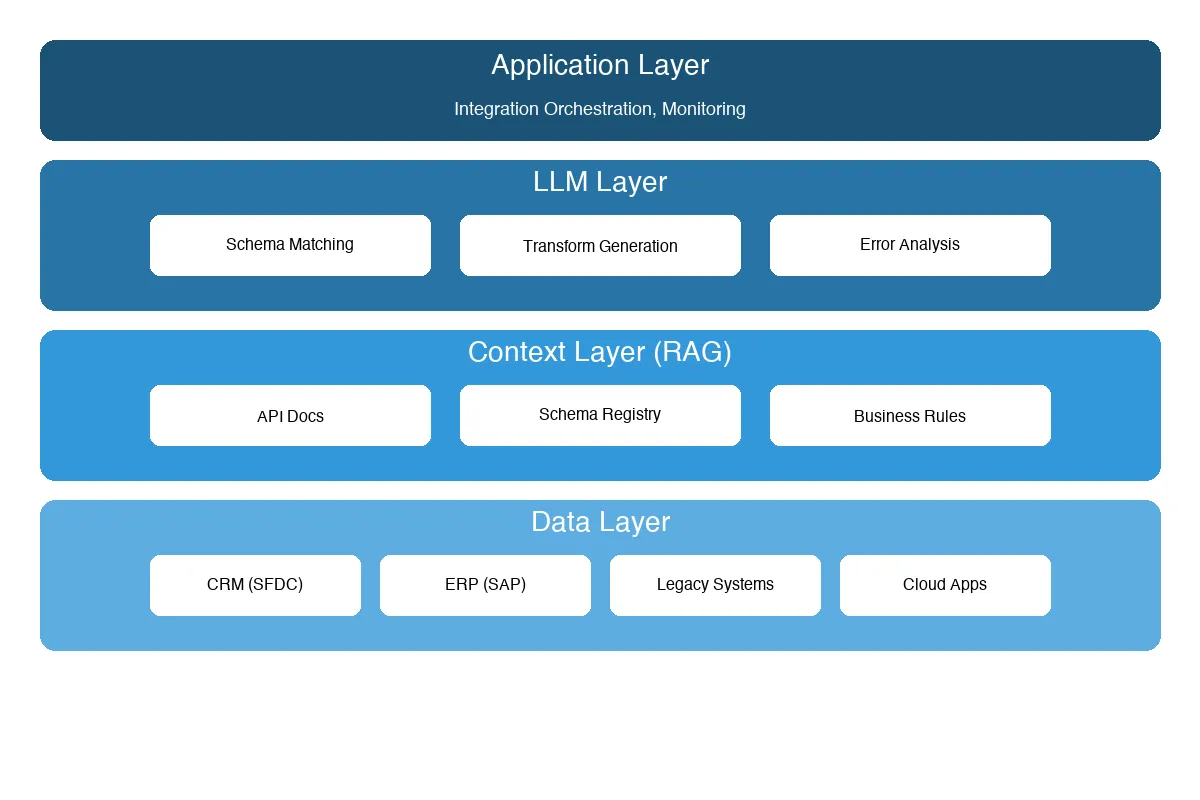
Here’s a high level architecture that can be used for LLM-augmented integration:
Key Components
Context Layer (RAG): This is critical. The LLM needs access to:
- API documentation and schemas
- Historical transformation rules
- Business domain knowledge
- Previous error resolutions
Without proper context, LLM suggestions will be generic. With rich context, they become highly specific and accurate.
LLM Layer: Handles the cognitive tasks:
- Schema matching with confidence scores
- Transformation code generation
- Error analysis and remediation suggestions
Application Layer: Orchestrates the integration flow using traditional tools (Step Functions, Apache Airflow, etc.) but leverages LLM capabilities where they add value.
Implementation on AWS
Services that can be used to implement this approach on AWS:
# Simplified architectureServices: - Amazon Bedrock: LLM inference (Claude, Titan) - Amazon S3 Vectors: Vector store for RAG - AWS Step Functions: Workflow orchestration - Amazon EventBridge: Event-driven triggers - AWS Lambda: Transformation execution - Amazon S3: Schema and document storageThe workflow:
- Event triggers integration (new record, scheduled batch, API call)
- Step Functions orchestrates the flow
- Lambda calls Bedrock for LLM-assisted tasks
- RAG retrieval from S3 Vectors provides context
- Generated transformations execute in Lambda
- Results flow to target systems
Real-World Applications
Several enterprises have already demonstrated significant results with LLM-powered integration:
Walmart developed an AI-powered Product Attribute Extraction (PAE) engine using multi-modal LLMs to extract and categorize product attributes from documents, dramatically improving catalog management efficiency.3
Moglix, an Indian digital supply chain platform, deployed generative AI using Google Cloud’s Vertex AI for vendor discovery, achieving a 4X improvement in sourcing team efficiency.4
Where LLMs Fall Short
It’s important to understand the limitations. Recent research from SAP reveals significant performance gaps when LLMs encounter real enterprise data:5
Dramatic accuracy drops on enterprise data: LLMs achieve F1 scores of 0.91-0.99 on public benchmark datasets for column type annotation. On actual SAP customer data, F1 scores dropped to 0.02-0.34—a collapse that highlights how enterprise data differs fundamentally from training data.
Custom schemas break the model: When predicting customer-defined columns (schema customizations unique to each enterprise), LLM performance dropped to near zero. Without enterprise-specific knowledge about custom fields, the models simply cannot generalize.
Data quality compounds errors: In payment-to-invoice matching tests, clean 1:1 matches achieved F1 scores of 0.97-0.99. Adding realistic data errors dropped performance to 0.58-0.89. Multi-match scenarios and multiple table structures pushed it down to 0.45-0.72.
Enterprise data characteristics: The research found enterprise tables have fundamentally different characteristics—43% empty cells (vs. 7-12% in public datasets), non-descriptive column names requiring domain knowledge, and complex data types stored as symbolic codes rather than clear numerical values.
These findings don’t invalidate LLM-assisted integration—they define its boundaries. LLMs excel at initial schema discovery and transformation drafting, but production deployments require human review, enterprise-specific context (via RAG), and robust testing against real data patterns.
Real-World Considerations
When LLMs Excel
- Greenfield integrations where you’re mapping systems for the first time
- Legacy modernization where documentation is poor
- High-variety, low-volume scenarios with many edge cases
- Self-service integration enabling business users to define mappings
When Traditional Approaches Win
- High-throughput, low-latency integrations (LLM inference adds latency)
- Highly regulated environments requiring deterministic behavior
- Simple, stable integrations that rarely change
- Cost-sensitive scenarios (LLM API costs can add up, though running models locally can change that math)
Hybrid Approach
The most practical approach is hybrid:
- Use LLMs to generate initial transformation logic
- Review and approve the generated code
- Deploy deterministically for production execution
- Use LLMs for error analysis and maintenance suggestions
This gives you the productivity benefits of LLM-assisted development while maintaining the reliability of traditional integration patterns.
Governance and Quality
LLM-generated integration logic requires governance:
- Version control all generated transformations
- Test coverage with representative data samples
- Human review before production deployment
- Monitoring for data quality issues
- Audit trails for compliance
According to Menlo Ventures’ 2025 State of Generative AI report, governance, data quality, and integration maturity are now essential pillars for scaling LLMs securely and cost-effectively across enterprises.6
Looking Ahead
We’re still early in this transformation. Key developments to watch:
- Specialized integration models fine-tuned on enterprise data patterns
- Agent-based integrations where LLMs autonomously handle exceptions
- Protocol standardization (MCP, A2A, ACP) enabling richer tool access7
- Cost reduction making LLM-assisted integration economical at scale
Gartner predicts that 40% of enterprise applications will embed AI agents by the end of 2026, up from less than 5% in 2025.8 Integration platforms will be at the center of this transformation.
Conclusion
LLMs don’t replace integration expertise—they amplify it. The deep understanding of business processes, data governance, and system architecture remains essential. But the tedious work of mapping fields, writing transformations, and debugging data issues? That’s increasingly something we can delegate to AI.
For integration architects, the opportunity is to move up the value chain: focusing on strategy, governance, and complex business logic while letting LLMs handle the mechanical work that used to consume most of our time.
What’s your experience with LLM-assisted integration? I’d love to hear about your approaches and challenges. Connect with me on LinkedIn to continue the conversation.
References
Footnotes
-
CrowdFlower, “2016 Data Science Report,” 2016. The survey of data scientists found 60% of time spent cleaning and organizing data, with an additional 19% collecting data sets. See also: S. Lohr, “For Big-Data Scientists, ‘Janitor Work’ Is Key Hurdle to Insights,” The New York Times, August 17, 2014. Available: https://www.nytimes.com/2014/08/18/technology/for-big-data-scientists-hurdle-to-insights-is-janitor-work.html ↩
-
“LLM Driven Smart Assistant for Data Mapping,” ICSE 2025 - Software Engineering in Practice (SEIP), International Conference on Software Engineering, 2025. Available: https://conf.researchr.org/details/icse-2025/icse-2025-software-engineering-in-practice/59/LLM-Driven-Smart-Assistant-for-Data-Mapping ↩
-
V. Nellutla, “LLM-Powered Applications: The Real Business Impact in 2025,” Medium, 2025. Available: https://medium.com/@vamsinellutla/llm-powered-applications-the-real-business-impact-in-2025-1b82efe17a4f ↩
-
“LLM Automation: Top 7 Tools & 8 Case Studies in 2026,” AI Multiple Research, 2026. Available: https://research.aimultiple.com/llm-automation/ ↩
-
M. Kayali et al., “Unveiling Challenges for LLMs in Enterprise Data Engineering,” arXiv:2504.10950, 2025. Available: https://arxiv.org/abs/2504.10950 ↩
-
“2025: The State of Generative AI in the Enterprise,” Menlo Ventures, 2025. Available: https://menlovc.com/perspective/2025-the-state-of-generative-ai-in-the-enterprise/ ↩
-
“MCP, ACP, and A2A, Oh My! The Growing World of Inter-agent Communication,” Camunda, May 2025. Available: https://camunda.com/blog/2025/05/mcp-acp-a2a-growing-world-inter-agent-communication/ ↩
-
“9 LLM Enterprise Applications Advancements in 2026 for CIOs and CTOs,” Lumenalta, 2026. Available: https://lumenalta.com/insights/9-llm-enterprise-applications-advancements-in-2026-for-cios-and-ctos ↩